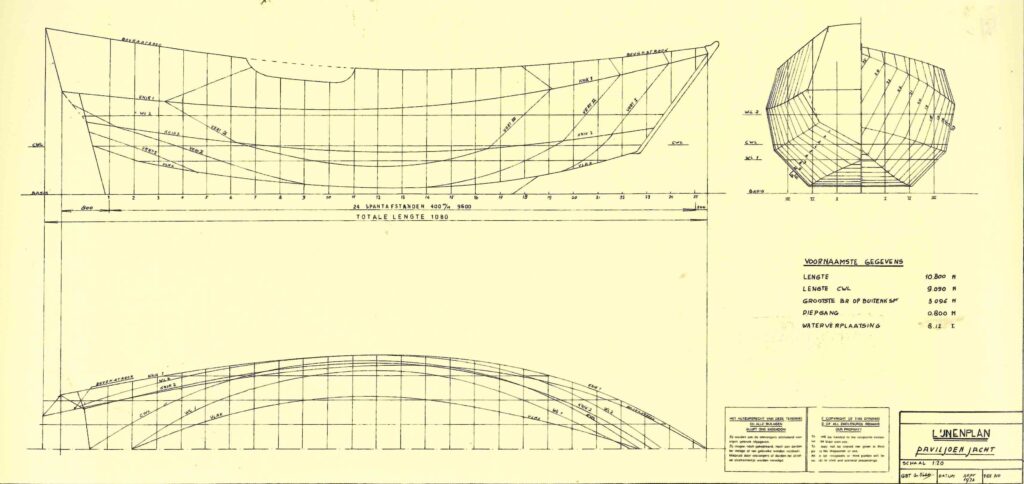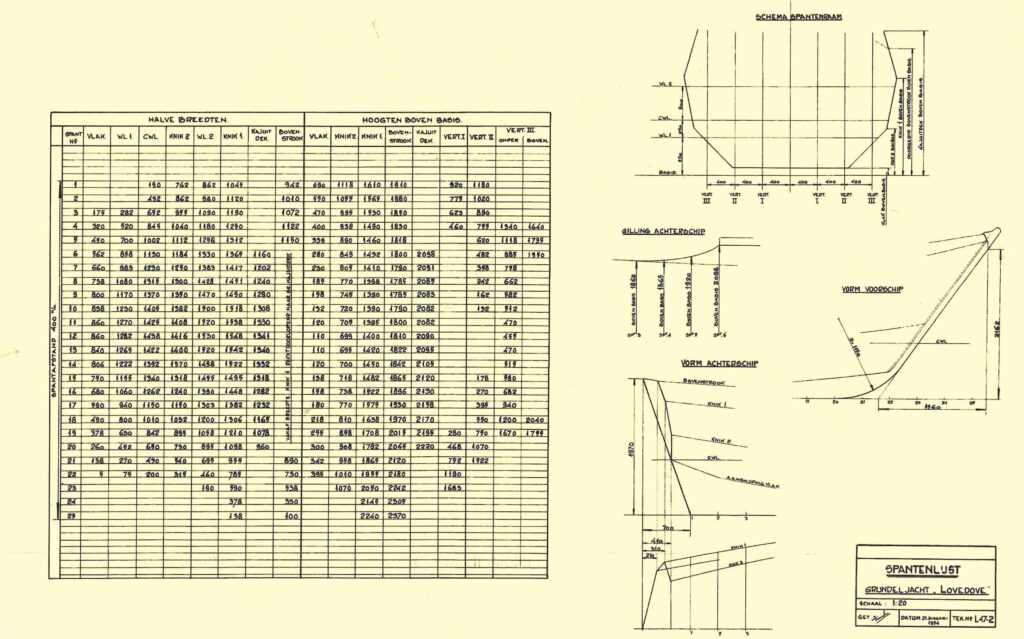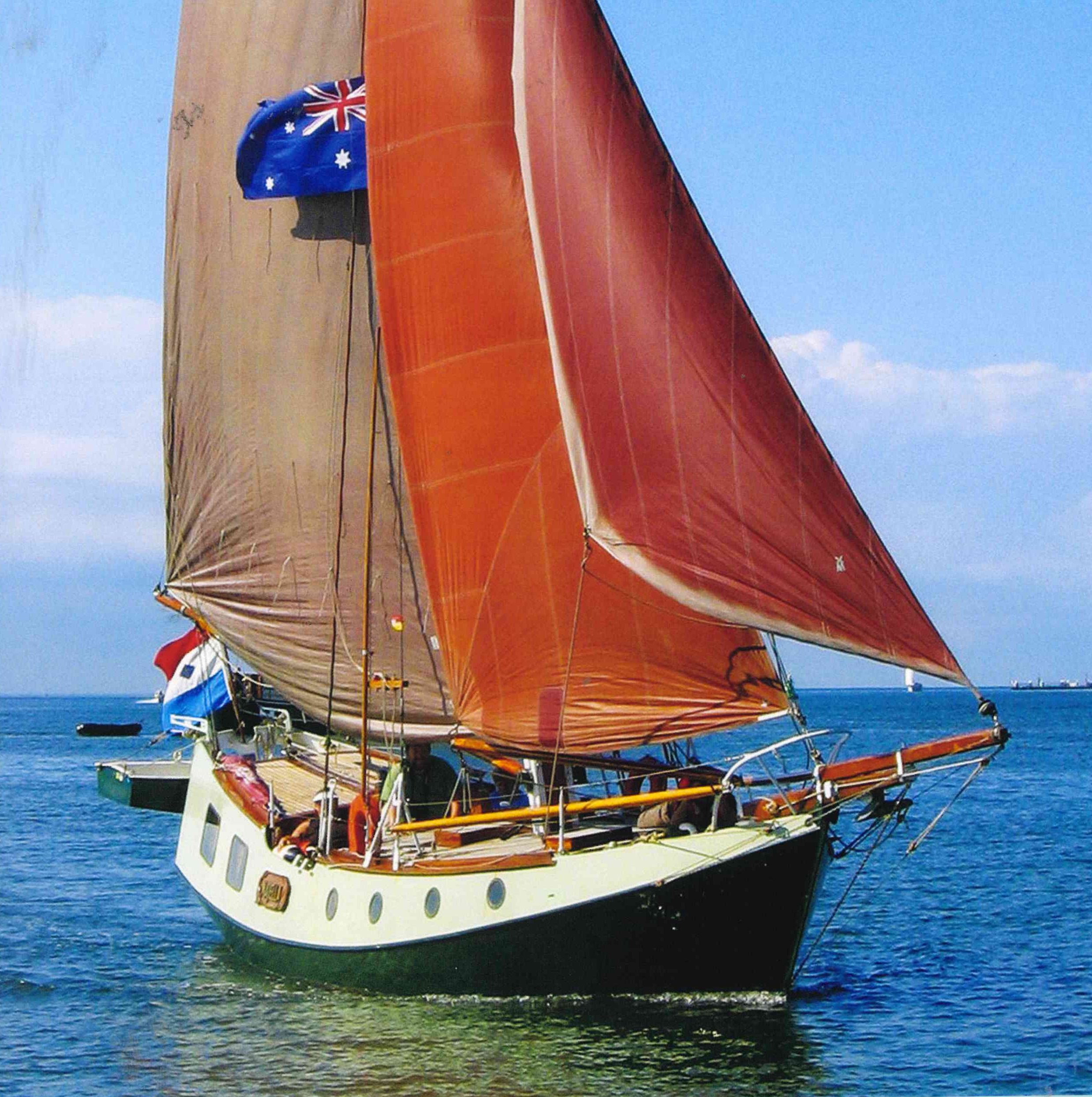
I remember first seeing an Alcyone II when I was quite young.
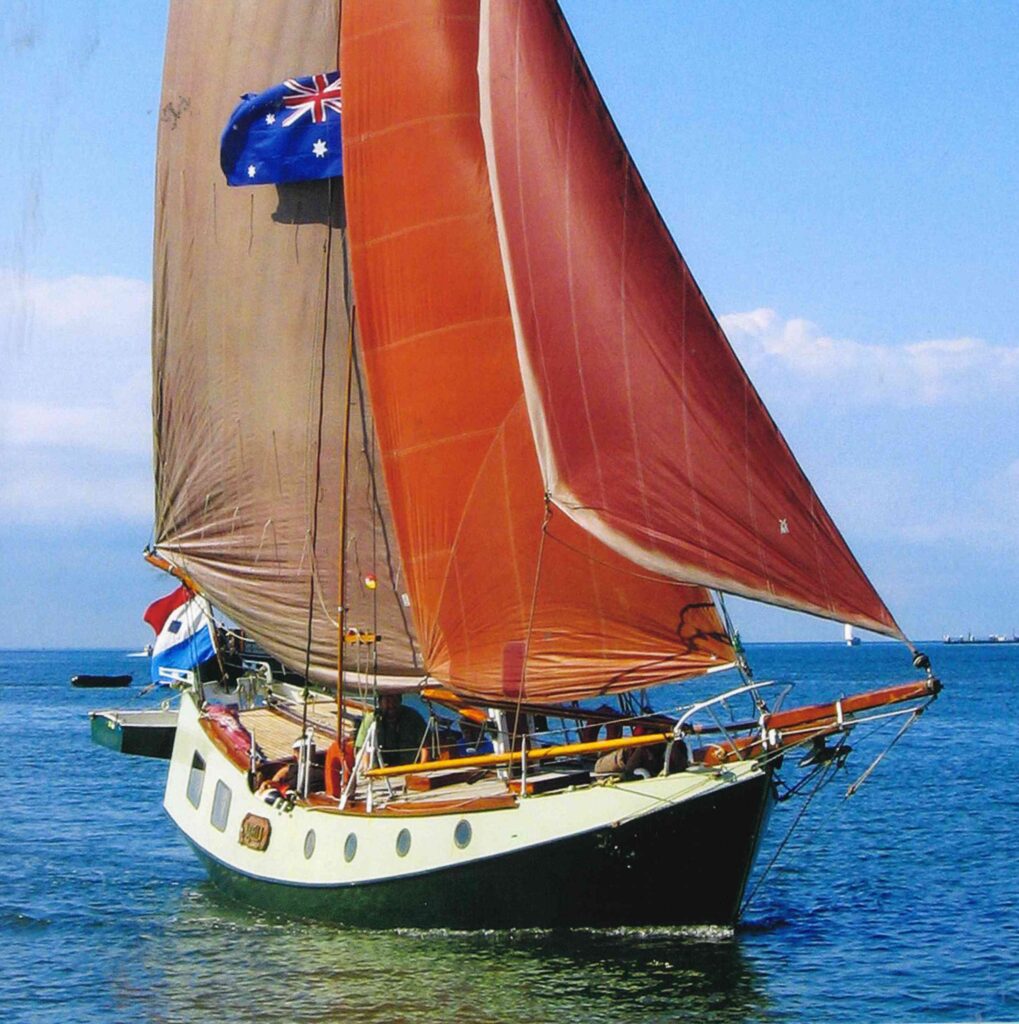
We were cruising Dutch canals in my Grandfather’s boat. It had this peculiar tan yellow color and looked like something from a different age and then again not. It flew a large American flag and appeared to be quite new.
It struck me as romantic and seaworthy and also like the kind of boat I would use to see the world.
Time went on and in 1984 I was working with Johan Valentijn when he mentioned that his family used to build these steel sailboats that had a center cockpit and a raised poop deck.
He showed me a picture, and the boat that struck me way back was the product of Johan’s family.
Johan was a little dismissive of the design, noting they were slow. To me the design had a lot of fascinating features, and obviously these were cruising boats, where speed is not a driving factor.
Time went on and a few years ago Johan shipped me a massive book “Alcyone Odyssee, The Ultimate story of a Modern Steel Grundeljacht”, by Arien van Boekel.
Johan provided a note that said: “I know you loved these boats and figured you would enjoy this book.”
I did enjoy the book, since it showed so much detail on something that was always a bit of a mystery to me.
The author traced the history of many of the boats and captured many photos of the various boats and the boat I think I saw as a child was shown in a few small pictures.
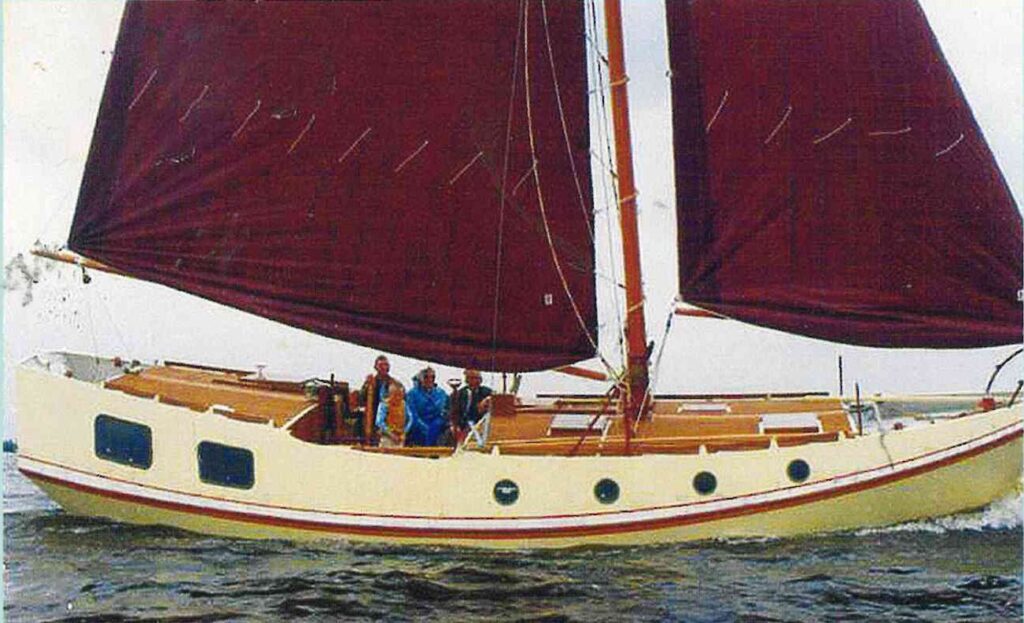
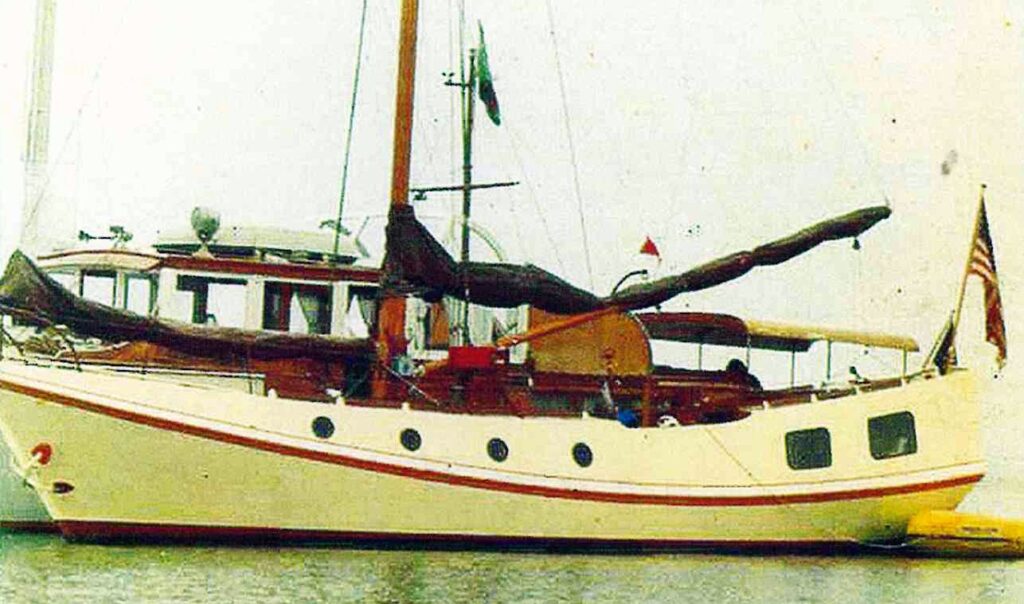
The boat was delivered in 1969 and I assume that is the year I saw it. The boat was named Isaac Ann and homeported in Boston, although the Owners apparently lived in Scituate. The boat was actually active in the area where I was working for Johan, but the author of the book could not find any further information on that boat after 1991.
The Valentijn yard stopped building these boats in 1984 and the yard closed a number of years later.
While a few may still be sailing, the design has faded into history and that is a shame since it has many features that are still significant today.
The boat was designed by professional naval architect, Max Gunning. He mostly worked in navy construction, worked on various Dutch navy surface ships, and was the originator of the three cylinder submarine design. He was not a professional yacht designer, and the yacht designs he created all were personal designs and only the Valentijn yard commercially build his yacht designs after he had commissioned the prototypes, with the 1956 Alcyone II being a development of an earlier personal design.
They were constructed in steel in the Dutch style, and I have discussed this approach in other blogs.
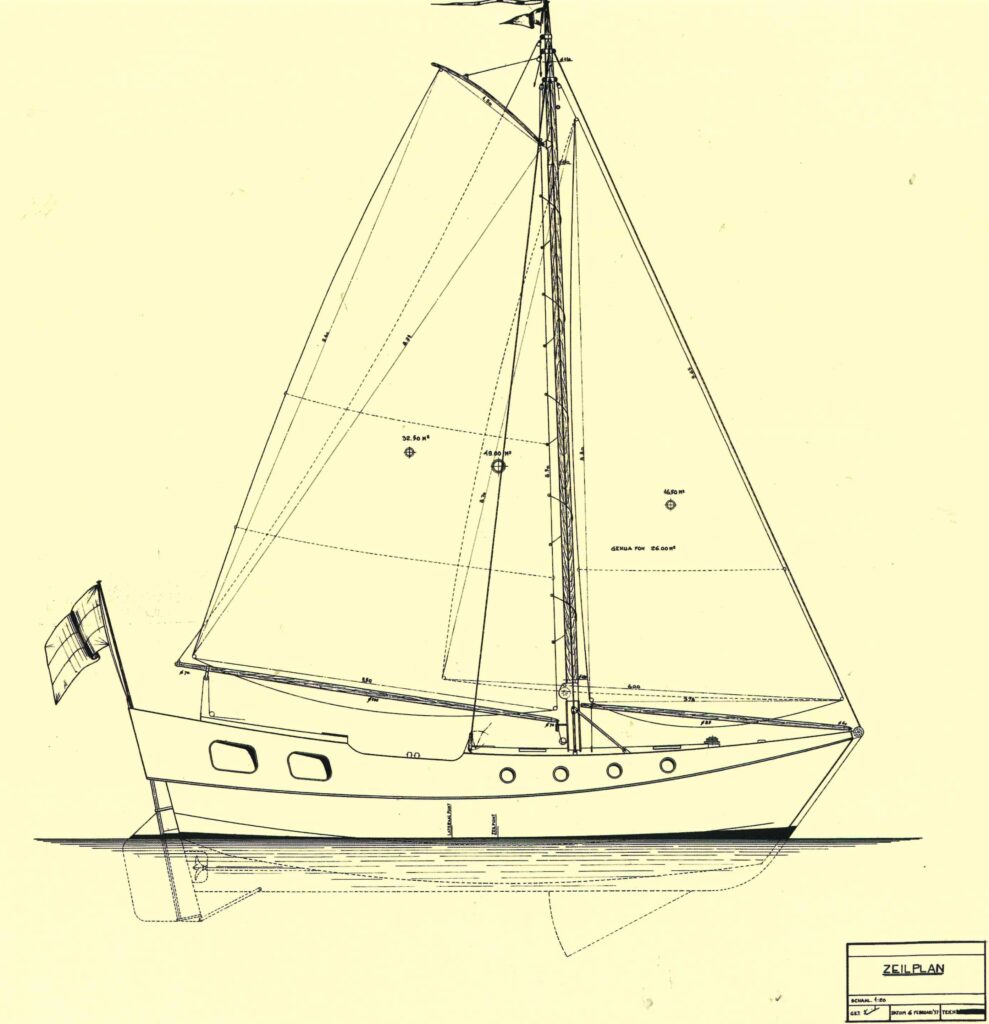
While they are flat bottomed, they are self righting in a knockdown. These are ocean sailors, and many have very comfortably crossed oceans. To think of a flat bottomed boat as self righting is unusual to say the least, but it can be done and relies on the bouyancy of the super structure which in this case is substantial without being too bulky. The center of gravity of the boat is lowered with a ½” steel bottom plate and two tons of leveling concrete in the bilges.
This design does not actually have a bilge. The top of the concrete is the cabin sole, and these boats are designed to operate with dry bilges. Sailors used to a smelly wet bilge may think it impossible to run with dry bilges. Ironically commercial mariners used to think that too, but today dry bilges are considered to be the norm and instead of a dealing with a smelly mess, today many commercial vessels maintain dust bunnies in the bilges.
Since they are flat bottomed, they can fall dry just like my present boat. This ability cannot be overappreciated. Cruising the Dutch Waddenzee, the English Coast or the Navesink River only becomes fun and easy when losing water to float in simply becomes an opportunity to enjoy a walk on a tidal flat or to inspect the bottom.
For sailing performance these boats are fitted with a very clever self lifting rudder and a centerboard.
The mast can be easily lowered which allows the boat to travel to places where other sailboats can’t.
These boats do not have a steering wheel, they have a vertical tiller. This may seem weird but it makes perfect sense and I copied this feature in the Crosley 24.
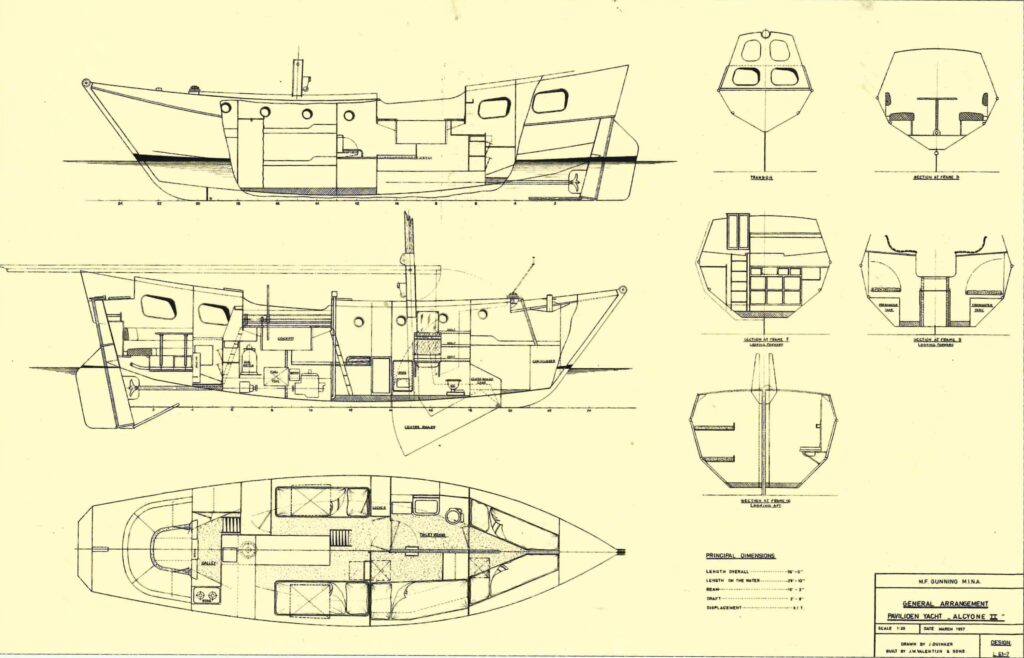
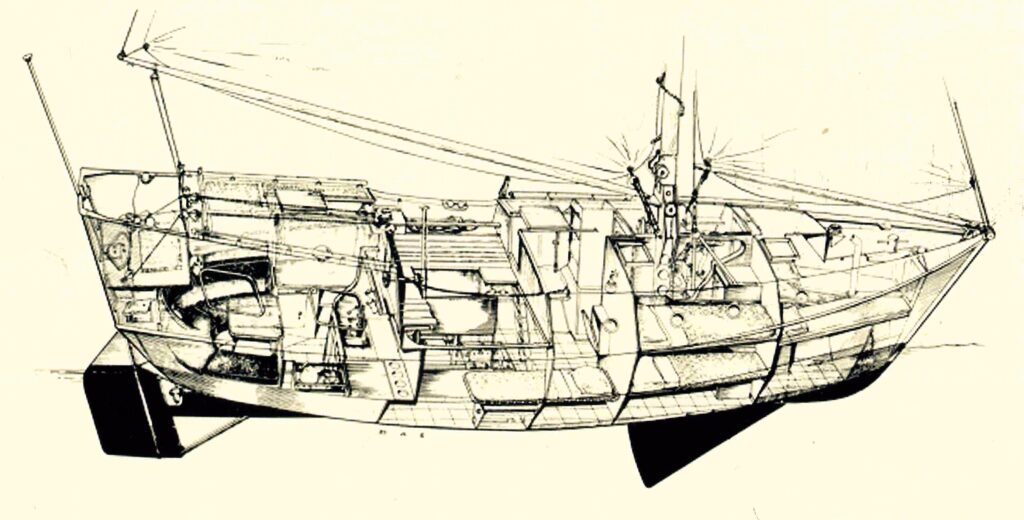
While the interior arrangement is not exactly as I would configure it, the center cockpit in a boat this size adds a tremendous amount of versatility. In a more modern design, a 44 foot center cockpit design often looks boxy, but it can be avoided with a raised poop like this.
A few years after this design, Gary Hoyt and Halsey Herreshoff also took this approach with the Freedom 40 center cockpit. That design had freestanding masts, but the Alcyon II rig is so simple that it negates the need for a freestanding mast. Moreover, it would be very difficult to design freestanding masts that can be lowered.
The self tending jib makes it as easy to sail as a Freedom yacht.
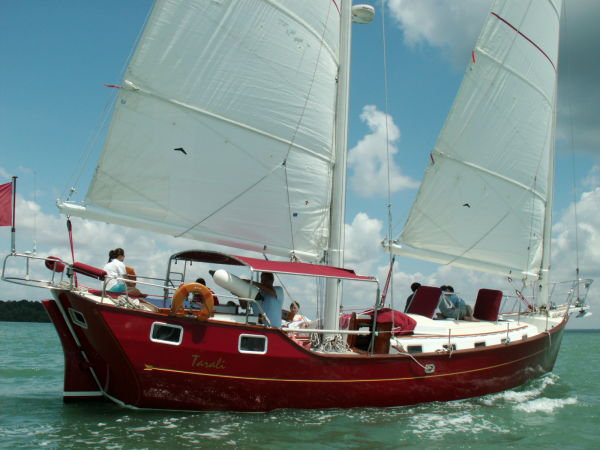
1976 Freedom 40 center cockpit
Center cockpits like this also have the advantage of ease of boom tent installation. (Or a bimini as shown on the Freedom). Generally, booms on aft cockpit sloops are too short to support a good boom tent at anchor but on this design a boom tent would add a tremendous amount of comfort at anchor (or aground on a tidal flat, or as a live aboard).
If I were to have any reservations about this design, it would be the steel construction. Steel takes maintenance and on large boats that becomes a burden. The book is filled with overhaul discussions and steel repairs for these boats and undoubtedly periods of neglect were the death knell of these boats after many, many years of service.
I don’t think this design can be executed in anything but steel, since the low center of gravity would be difficult to achieve and then it would lose the self righting feature. However, coatings have much improved and I might even fiberglass epoxy the hull to provide better corrosion resistance.
The book also provided an interesting foot note. It mentioned that Ed Bullerjahn had asked the Valentijn yard to design a 58 foot version of the Alcyone II. It was one of Johan’s first design assignments, but was never built. The book provided more background on Ed Bullerjahn’s career as an architect and while not everybody loved the esthetics of these vessels, Ed’s fine eye must have approved of it, which is good enough for me. I love the general appearance but would alter the design somewhat. I particularly think that making the stem angle a little steeper would improve the visual balance. The design is reflective of the traditional Dutch grundel, which, ironically, I consider to be the least attractive of the Dutch traditional designs.
I really enjoy thinking of where I would take a boat like this, but it also makes me a little sad, because only a few of these remarkable boats have survived, and the chance that I can enjoy a sail on one is very slim.