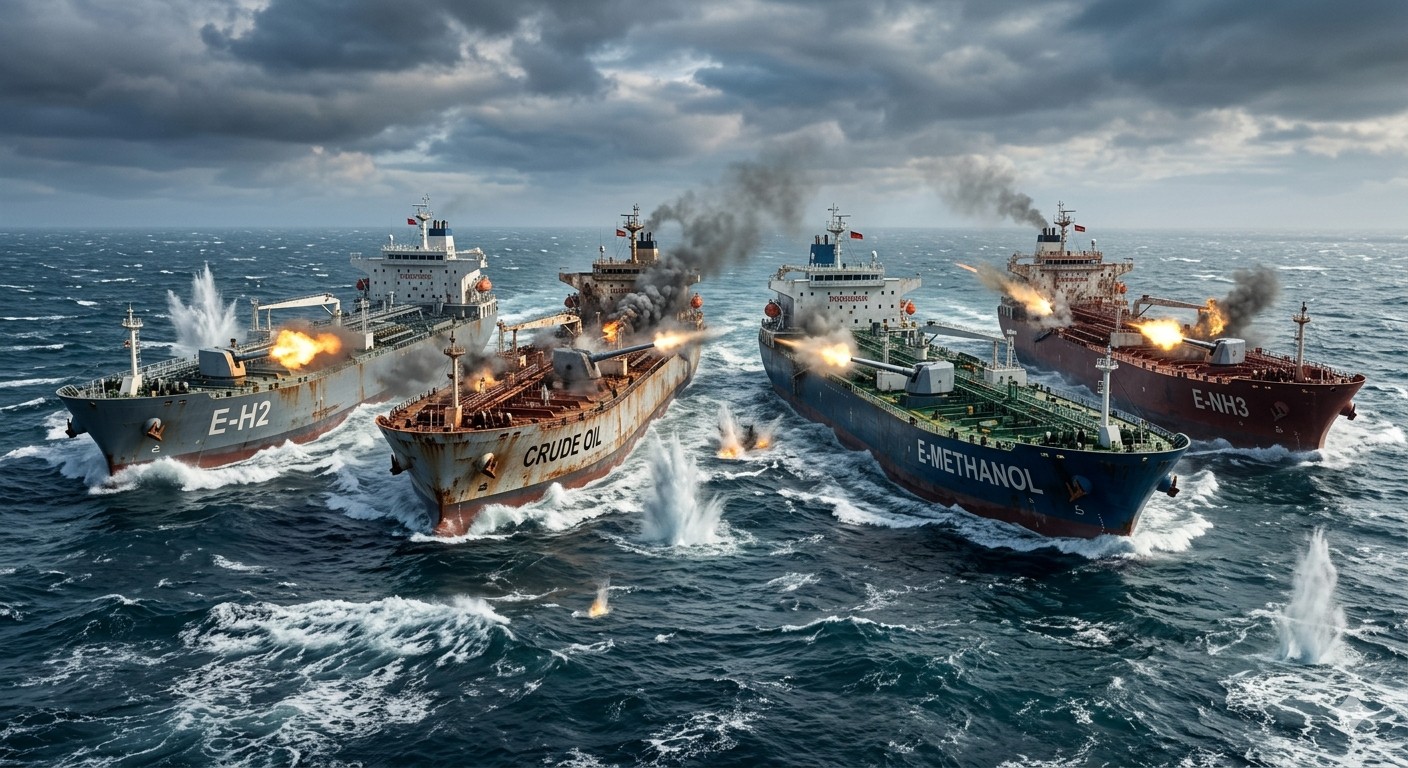
In the transition to sustainable fuels one of the main arguments relates to what fuels to use. Then almost immediately, the argument shifts to the cost of the truly sustainable fuels and the industry debate gets all wishy washy and resists a change to truly sustainable fuels (E-Fuels) as long as possible. With continuous pressure the industry then agrees to lower cost alternatives such as transitional fuels and steaming restrictions and fossil fuel efficiency ratings and continues to resist.
But the Borg is right: Resistance is futile. E-fuels will take over and even Jean Luc Picard can’t stop it.
Meanwhile, the industry will argue that the cost of these truly sustainable fuels will be the end of the world.
There are other ways to produce limited quantities of truly sustainable fuels, but in the end the vast majority of sustainable fuels will be E-fuels; Fuels for transportation devices produced with electricity. Which means that we will be using sustainable electricity to produce the fuels that are being considered for transportation devices.
That list appears to focus on E-Liquid Hydrogen, E-Ammonia, E-Liquid Methane, E-Methanol and E-Ethanol. (For reasons that take too long to explain, I am excluding aviation, which may be using slightly different E-fuels).
There are other options, such as wind, direct solar, batteries or nuclear. I am especially eager to see nuclear advance, but at the moment these options are best thought of as niche applications, while for general use hopefully one E-fuel will simply take the place of all liquid transportation fuels we presently use, such as HFO, diesel and gasoline.
Based on present technology and manufacturing base, these E-fuels will be more expensive. However, how much more expensive is very difficult to figure out.
Using internet and AI I spent some time researching the cost of these E-fuels.
That is very difficult to do by humans, search engines and AI, but I did come across a table that provides some costs (and I deeply and sincerely welcome input from anyone who has better numbers).
These costs resulted from an ASME evaluation. I will not provide further reference since I do not want to provide it with too much legitimacy. The subject is so incredibly complicated and the numbers can change so rapidly that these costs serve as a starting point, but warrant continuous updates. I will add that, as an engineer, I can see these costs make relative sense and conform to some other estimates that I have seen.
The table lists the Minimum Fuel Selling Price (MFSP) based on techno-economic analyses (TEA) of E-fuels production in the 2025 to 2030 time frame.
MFSP Comparison Chart (ASME) (Estimated 2025–2030)
Values are estimated, normalized based on lower heating value (LHV) for comparison based on available literature.
| E-Fuel | Estimated MFSP Range (USD/MWh LHV) | Typical Cost Driver |
| Green H2 (Liquid) | ~$100 – $160/MWh | Electrolyzer + Liquefaction |
| E-Ammonia | ~$90 – $130/MWh | Green H2 + N2 supply |
| E-Methane (Liquid) | ~$120 – $180/MWh | Green H2 + CO2 capture |
| E-Methanol | ~$130 – $200/MWh | Green H2 + CO2 capture |
| E-Ethanol | ~$150 – $220/MWh | Complex Synthesis |
While E-Ammonia appears to be the winner, it still loses against the cost of fossil fuels, which operate in the range of $40-$50/MWh for HFO/VLSFO and $70-100/MWh for diesel/gasoline.
The largest portion of the cost of these E-fuels is the cost of electricity, typically accounting for 60–80% of the total MFSP, followed by electrolyzer capital expenditure (CAPEX).
For some of these E-fuels the cost of liquefication is also a significant component. If electricity were to become very inexpensive, the heavily refrigerated liquid fuels (E-H2 and E-LNG) would become slightly less expensive relative to the other E-fuels.
In this cost comparison E-Ammonia appears to be the winner, but that is only the tip of an incredibly complicated iceberg. But let’s first discuss the cost effect of E-fuels in general.
While at present these E-fuels appear to be non-competitive, if electricity were to become very inexpensive (which is not inconceivable) and with increases in scale and commoditization, and advancing technologies, the cost of E-fuels could rival the cost of present-day fossil fuels. This is not something that is often mentioned but is pretty nice to realize. E-fuels would also lessen the Strait of Hormuz effect where the cost of fossil fuels can spike quicker than E-fuels.
Technically the higher cost of these fuels may not be factor at all, since in many transportation devices the conversion of these fuels to work could be much more efficient than traditional fossil fuels. Many of these E-fuels are conducive for use in fuel cells with electric drives, which are much more efficient than internal combustion devices.
The initial equipment cost of a liquid hydrogen to fuel cell to electric drive propulsion system is presently much higher than a simple diesel plant. However, if one were to assume that power components (initial purchase) had the same cost, a liquid hydrogen fuel cell ship at 80% thermal efficiency would pretty much cost the same to run as a fossil fuel internal combustion ship at 40% thermal efficiency.
This is still a tip of the iceberg discussion, since a liquid hydrogen ship may not have the range or cargo carrying capacity of a fossil fuel ship, but it points at an interesting issue. There are no technological barriers to sustainable transportation, and once the change to fully sustainable transportation has been made, it is highly likely that there will be very little difference in transportation cost as compared to fossil fuel days.
However, where the rubber really hits the road, one needs to realize that the resistance to transition to fully sustainable propulsion is not related to technical or cost barriers, but is related to the competitive nature of transportation, where the relative cost of fuel is a major factor for a commercial transportation operator. This means that just a few percentage points difference in the cost of fuel compared to a competitor can be devastating, or the source of massive profits.
This is why heavy fuels were so massively adopted by ship operators. Once one ship operator was using this less expensive fuel, the others had to follow suit. If the use of HFO’s had been outlawed, ship operators would have continued to use diesel fuel, which would have increased the cost of transportation by a tiny percentage but would not have affected the relative competitiveness and profitability of ship operators.
Once sustainability is considered, cost cannot be the only driver. HFO won in ocean transportation based on cost, but may also be the most damaging fuel in use, based on emissions, crew impact, environmental hazards and many other factors that tend to hide behind a low cost façade.
Bottom line: Ship operators don’t care what fuel they use and what it costs, as long as their fuel is not more expensive than the fuel their competitors use. As such, ship operators are not terribly useful in the selection of the best E-fuel, but it argues for the selection of a single fuel to keep an even playing field for ship operators and to improve scale efficiencies where this fuel will not only be used in ships but also in long range land vehicles, recreational vessels and emergency generators.
In the selection of the optimal E-fuel, a full system approach needs to be taken where cost may only be a minor factor.
I am presently part of a SNAME T&R Alternative Fuels panel that is engaged in identifying a full system solution that addresses the combination of cost, sustainability, design, maintainability, user friendliness and well to wake efficiencies.
If you are interested in participating, feel free to contact the panel chairman:
Ioannis Chalaris
Chair, M-50 Alternative Fuels Panel | SNAME T&R Program, Ship’s Machinery Committee
Department of Naval Architecture, Ocean & Marine Engineering | University of Strathclyde
Tel: +30 6981448221 | Email: ioannis.chalaris.2020@uni.strath.ac.uk