

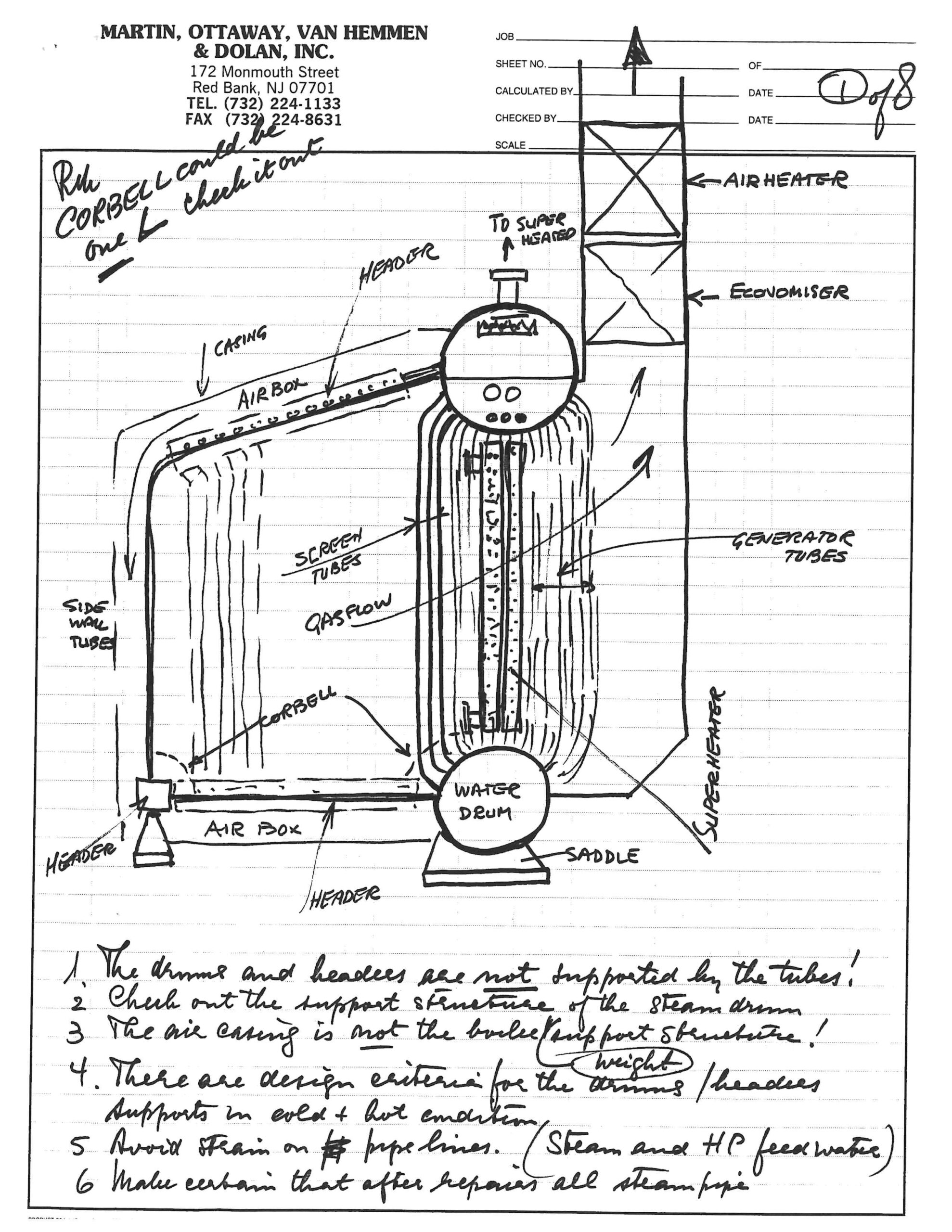
Around 1996 I had a job in Singapore that dealt with a boiler damage. The real steam engineers in the office were not available and I was the last surveyor standing. I was worried about my limited knowledge of boilers and asked my father to provide me with a primer.
He hand wrote 8 pages of boiler information complete with sketches. It was 8 pages of stream of consciousness with very few second pass corrections. I recently found it, and was deeply impressed with the truly useful content and the incredible skill of my father in pushing this out so quickly.
I titled this blog a “Steam Course on Boilers”. A steam course used to be a super fast, on the fly, course on a subject. Oddly, in recent years it has become something else where STEAM is STEM with Art. I have written about the inherent fallacy of the concept since the Art component is too often interpreted as: “Art also deserves to be taught in school”.
I have argued that the Art component has a place in STEM, but only when it reinforces STEM. It only works when someone in STEM can use Art to strengthen the message. And when Art is included in STEM education, Philosophy, History and Language should also be part of STEM, which then results in STEMPHLA.
Meanwhile, feast your eyes on real STEAM and for those with an interest in ship’s boilers there is some mighty useful information on boiler damages and repair too. While Henk had beautiful cursive handwriting, my assistant Mirna has transcribed the cursive text in the document to avoid having to decipher some of the technical terms.
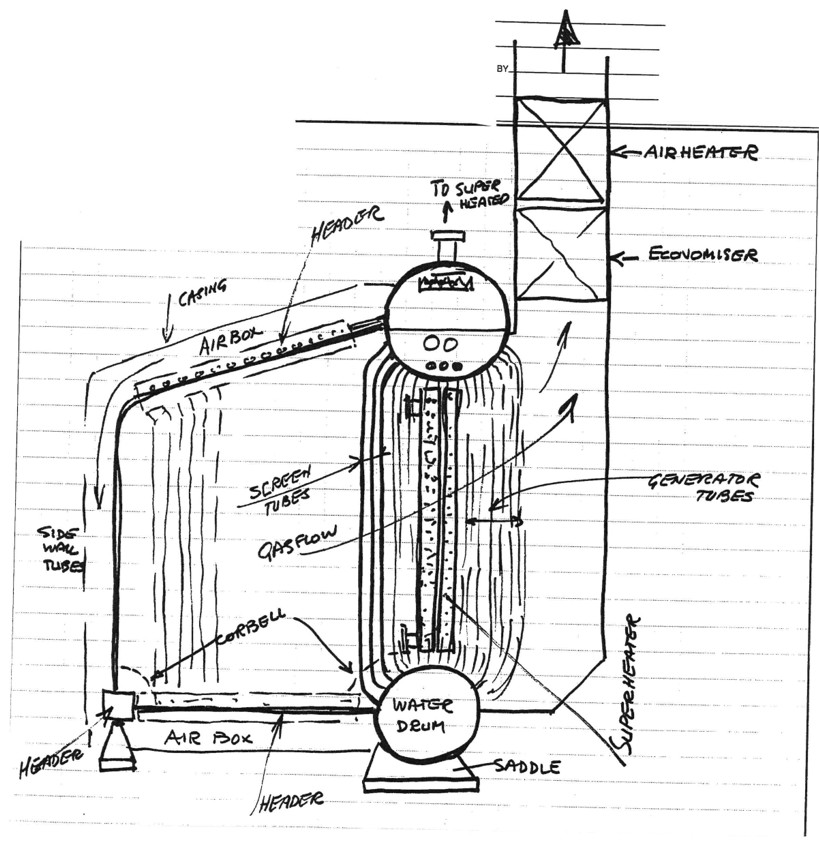
- 1. The drums and headers are not supported by the tubes!
2. Check out the support structure of the steam drum.
3. The air casing is not boiler weight support structure!
4. There are design criteria for the drums/headers supports in cold and hot condition.
5. Avoid strain on pipe lines. (Steam and HP feed water)
6. Make certain that after repairs all steam pipe and feed lines are adequately supported by (frequently) spring loaded suspension points. (units). 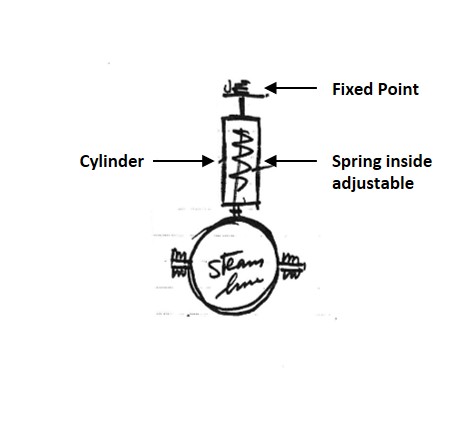
7. If casing is bulged, normally the refractory carrying structure is deformed and you will never know how much the refractory work (fire brick) is loose from the anchors. Check out carefully!

8. If side wall tubes are bulged and hydro test is ok (cold) you still may have leakages when firing up because the tube rollings may be disturbed.

Plugging such tubes will not help. Re-roll/Re-expand those tubes. Does not make it overall nicer though.

Look for the boiler tube drawings. (instruction book) (“pressure element” it is commonly called)
That drawing has a listing of tube gauges and numbers.


I have never seen a furnace bulging on a tube(s) rupture only.
Down comers are heavy wall thickness tubes and keep the drums at distance but are not the supports in operations, those are return water tubes.
Mind you that all the tubes, complete in itself, and intact! form the envelope of support, but that the weight of the water, expansion and contraction (load condition), motion of the ship etc. require some form of support has to be checked. The foundation has to be checked.
Field Survey
• Start describing the boiler make and type.
• Refer to drawings, instruction book etc., saves a lot of dimension descriptions.
• Describe tubes as: bulged, blistered, split open, heat-affected, out of the original alignment by ½” – 1” etc.
• Also watch where tubes are apart thus exposing the underlying insulation and brick work to excessive heat.
• Screen tubes are screening the super heater, but basically all furnace walls tubes are screen tubes shielding the under lying refractory against excessive prolonged radiation heat!
• All boiler damages require an opinion from the manufacturer and/or designer.
• Eyeballing is fine, but boilermakers are not boiler designers!!
Recommendations: Renewal of tubes, not straightening, that is half ass work.
• Remember any blemish outstanding on a boiler directly affects the vessel’s reliable operation and market value.
• There is no such things as trying and hoping for the best as a permanent repair.
• One rotten tube in an otherwise ok boiler can be detrimental. So be generous in renewals u/w’s surveyors know (should know) that!
Notes (as applicable)
This is a general list you can pick from:
A. Necessary removals for access to and in connection with repairs including replacement afterwards mainly comprising:
Access doors and panels to the combustion air spaces, casing structure and boiler support structure
Burner registers, fuel oil lines, furnaces and associated appurtenances
Man hole and hand hole covers to steam, water drums and headers including gaskets
Steam drum and water drum internals baffles and deflectors, steam separators, internal feed and blow down lines, internal desuperheater heater coils
Furnace brick work, insulation material, castable refractory work, refractory anchors and securings
Steam, blow down, feed lines in way of repairs
Electrical wiring, boiler control pneumatic lines, gauge board, instrument panels, control equipment and protection devices in way
B. Upon completion of repairs the boiler pressure element to be chemically cleaned and neutralized.
C. Hydrostatic testing to be carried out to the satisfaction of US Coast Guard and Classification Society.
D. Necessary supply of furnace refractory material, insulation material, gaskets and jointing, bolts and nuts, sealing material and general hardware
E. Necessary attendance of a boiler manufacturer’s representative.
F. Upon completion of repairs all boiler control protection and safety equipment to be thoroughly checked by a qualified boiler control specialist.
G. Upon completion of repairs all sliding foundation support feet and boiler holding down devices as well as steam and feed line suspension arrangement to be cleaned and checked for proper functioning as per manufacture’s set criteria.
H. Clearances and tolerances to be recorded in protocol of measurement.
I. Necessary removal of dust and debris resultant from the repairs
J. Necessary transportation of men and material to and from the vessel
K. Scrap resultant from repairs is of no commercial value
Rik:
- 1. When you see blocked, clogged, restricted passages and only if this could be casually related, think about poor soot blower conditions, non-functioning soot blowers, failure to soot blow etc. (crew negligence!)
2. Failure to vent the furnace prior to lighting off (crew negligence)
3. Jury rig, screwing around with controls (crew negligence)
4. Not shutting down in time, [combined with f***’d up controls] (crew negligence)
5. If tube splits because of internal (water side) problems look at boiler water control. Did owner supply the means? Contract with chemical supplier, to check as well? Samples collected by supplier? Crew does not follow-up!
6. When were tubes last time renewed?
Boiler tube renewal after 15 years (sometimes 10 years) no matter how good the treatment of water is, not uncommon under high load conditions
Super heater renewal after 15 years on HP boilers is a normal budget reserve (HAL pass. ships)
Super heat tubes at >400°C are without exception alloy tubes (chrome – molybdeum) CREEP!
General:
A leaking desuperheater coil in the water drum (gas gasket) can disturb the boiler circulation where in a bad case, screen tube(s) fail. Got to be a bad leak though. You can see that also in the boiler water test reports because it fucks up the water readings. Not something to start with!
List owner’s supply.
