M&O has designed many load outs and complex lifts on salvage and construction jobs, and has provided warranty surveys on complex lifts and load outs.
The International Cargo Gear Bureau (ICGB) was founded in 1954 and is a US Government designated not-for-profit organization providing surveying, testing, and certification services for maritime and land-based lifting equipment.
It is authorized by the U.S. Coast Guard and OSHA, and it ensures compliance with safety standards for cargo gear, recognized by ILO and IMO.
These certifications can also be performed by other organizations, but ICGB provides a one shop stop for land based and ship based cargo gear with designated surveyors around the country.
Martin & Ottaway acts as designated inspectors for the International Cargo Gear Bureau at various locations around the US, including the Northeast and Gulf.
Cargo gear is sometimes difficult to define, but can be simplified by calling it lifting gear. Some lifting gear is not directly certified under USCG and/or OSHA regulations, but still needs testing and certification for general safety and for contract purposes.
Recently M&O attended on such a situation where our client Carver Marine Steel Works at Coeymans, New York had built a sophisticated travel lift enhancement. Normally travel lifts use slings to lift ships, but travel lifts are very versatile devices and often are the most powerful lifting device in a shipyard or construction facility and may see service for less conventional lifts.

Carver had constructed custom lifting beams to an approved design for its 820 ton travel lift and now needed load testing and certification to allow them to enter service for its customers.
Lifting beams allow loads to be raised higher than with belly straps, especially when the load is narrow. Raising the load in straps on a travel lift results in the straps becoming more horizontal which results in horizontal compression of the travel lift main hoist beams and eventual overloading of the straps.
This lifting beam system was designed to lift the travel lift capacity at the center of the beam, resulting in a simple point load on the beam. However, no sufficiently large single test weight was available.
M&O performed the calculations to load the beam to an equivalent point load using a higher distributed load, while preventing overloading of other travel lift and lifting beam components.
That became quite a puzzle to achieve this with the available weights, but an appropriate solution was found.
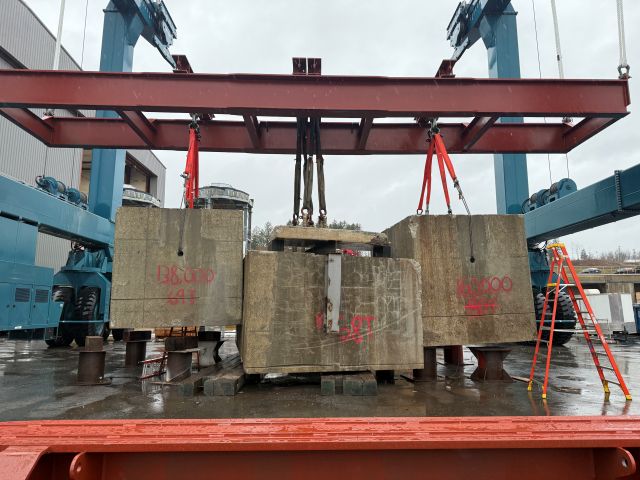
Because the lifting beam was fitted with adjustable lift points (using sliding cross beams) with varying capacities, the complete test of all load cases and components was a two day job involving reconfiguration and loading of a large number of different test weights and beam components.
Besides the puzzle of determining proper loading, there was a second puzzle in figuring out the most efficient reconfigurations and load tests of all load points and all load configurations without unnecessary shifting efforts and replications.
The client now has a properly load tested and extremely versatile travel lift enhancement that from a user’s point of view, has a simple rating without hidden flaws and hopefully will be a useful and valuable tool in the yard’s construction and repair projects.
Call us when lifting gear certification is needed, especially when it is complicated. We love technical puzzles.