Today we have to be so careful about believing our eyes. To create a fake AI picture is a trivial exercise, and people need to learn to be very cagey about believing what they see.
Not every sector of the population is affected the same way. Magicians or illusionists have known for centuries not to believe their eyes, because they know that what the eye sees is not what it may actually be.
Forensic engineers are also inherently critical about information. In forensic investigations even real life video can fool the eye, and so can real life photos.
We learn to evaluate every detail and have done so long before the internet was even a thing.
Before the internet there were snail mail newsletters. Martin & Ottaway published one and so did our friends at Longo Industries. Longo’s newsletter was nicer than ours; they used shiny paper and it had real shiny photos.
In 1993 Wayne Thomas took a casual look at a Longo newsletter on my desk and said: “They say this picture was taken in 1957, but it has to be later.”
I looked at it and agreed right away. There was a faint reflection of a car in the window and that car definitely was not a 1950’s car.
We sent a note to our friends at Longo and in their next newsletter they provided a correction.

It was all in good fun in those days, but today, we have to pay much closer attention.
Does that mean that the world is going down the tubes? Maybe, maybe not.
In the note to Longo we said that the engineers in our firm “believe this photograph was taken in the early sixties”. (In retrospect I suppose I should have said: “After the early sixties”; it may have been an old car.)
We were tempted to fully identify the car model and year to really impress them. We suspected it was an early sixties Dodge Dart or a Plymouth Valiant, but to confirm that, we would need to find a reference. Our company library was (and still is) extensive, but we did not carry an illustrated 1960’s car guide in it.
We’d have to schedule a trip to a library, take out books, and compare pictures. Since this would be unpaid research and we had, and still have, a particular dislike of the hard frustrating work in public and university libraries, we stayed vague.
Today it is easy. As engineering pinheads we already had a hunch.
All we would have to do is Google: “Image Plymouth Valiant”.
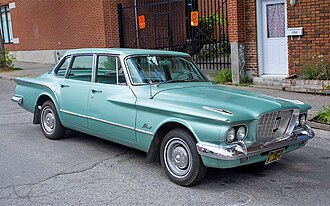
That is a 1960 Plymouth Valiant, it had to be a later model.
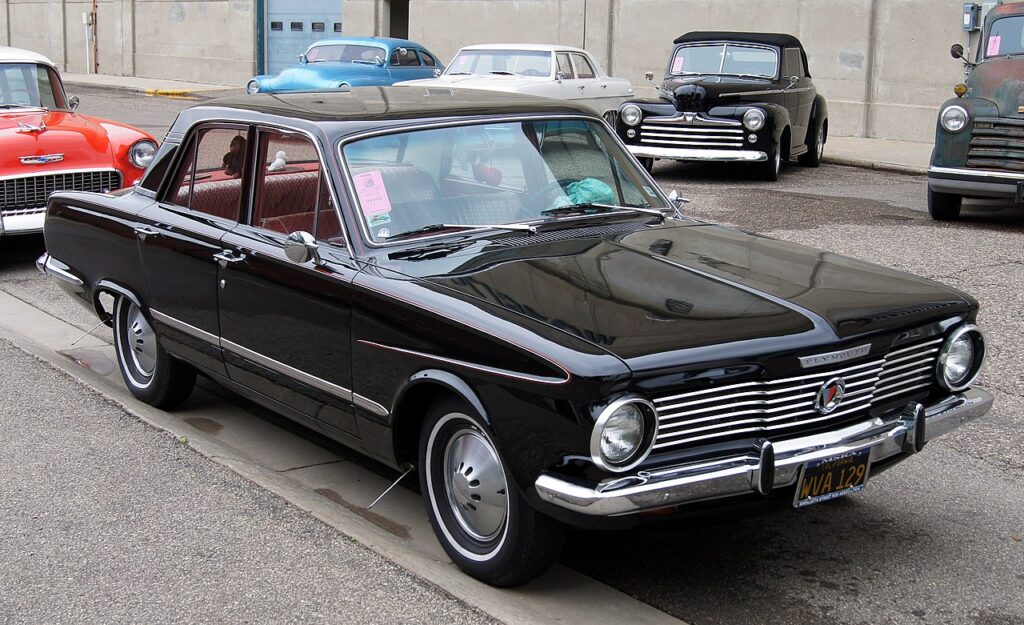
This one, a 1963 model, is the right era, and roughly similar, but not really the right car so Google: “Image Dodge Dart”

And there it is, a 1963 Dodge Dart.

To really nail it down, this is a near identical 1963 model, but without the chrome headlight bezels. The Longo car must have been a deluxe model, or this one lost its bezels.
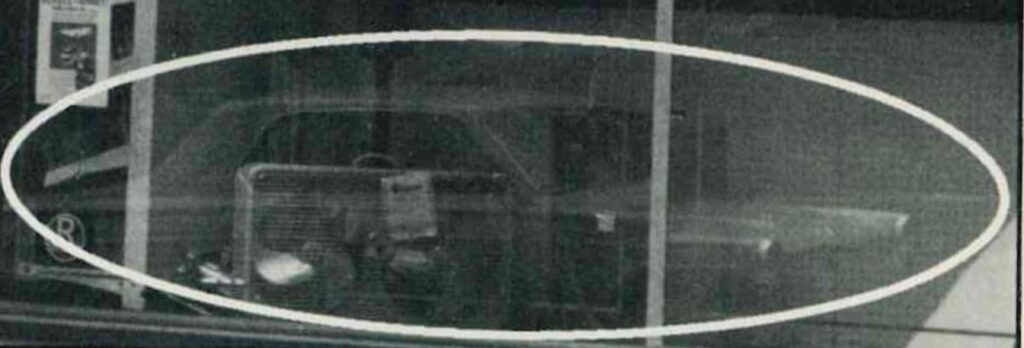
Even if we had no hunch as to what the car model and year was, today, we could crop out the faint car reflection and use a graphics capture of the reflection to search for more images like it.
It would be rather sophisticated work, but in the 1990’s that technology was no more than a glimmer in the computer engineer’s eye.
There is a moral to this story. We live in an ever more confusing world, but we also have much better tools to dig down and find the real truths. It is a form of combat, and only the sharpest observers and problem solvers will survive. But that is nothing new, the world belonged to those people in the past and will continue to belong to those people in the future.
Pay attention. And use all the tools at your disposal; your eyes, your brain, your knowledge, your experience, the internet, AI and dependable references to keep control of your world.