As late as 2022 MARAD was still considering the conversion of the SL7/FSS vessels. In particular MARAD wanted to replace the steam plants with more modern internal combustion plants.

MARAD was pretty much the only ship operator that was still running steam plants and saw a manning problem where it would become ever more difficult to find qualified steam engineers to operate these vessels.
That was in 2022 and the only repowering options were diesel or gas turbines. In the final study gas turbines were considered to be the best option and the installation of a gas turbine plant would cost around $150,000,000.00. During the study there were various other well thought out modifications that would increase the cargo worthiness of these vessels and the overall conversion would cost as much as $300,000,000.00 and extend the lives of these vessels by 20 to 30 years.
It cannot be overemphasized that while these vessels are old, they are not tired. In effect they are the B-52’s of the maritime world.
MARAD has a method of scoring the cargo worthiness of sealift vessels called Vessel Acquisition Management (VAM) Score. Oddly, the SL7/FSS vessels scored quite high on this matrix, both before and after potential conversions. Regardless, MARAD decided against a conversion and soon thereafter these vessels were being delisted for eventual disposal.
MARAD changed focus and today very strongly appears to be interested in nuclear propulsion.
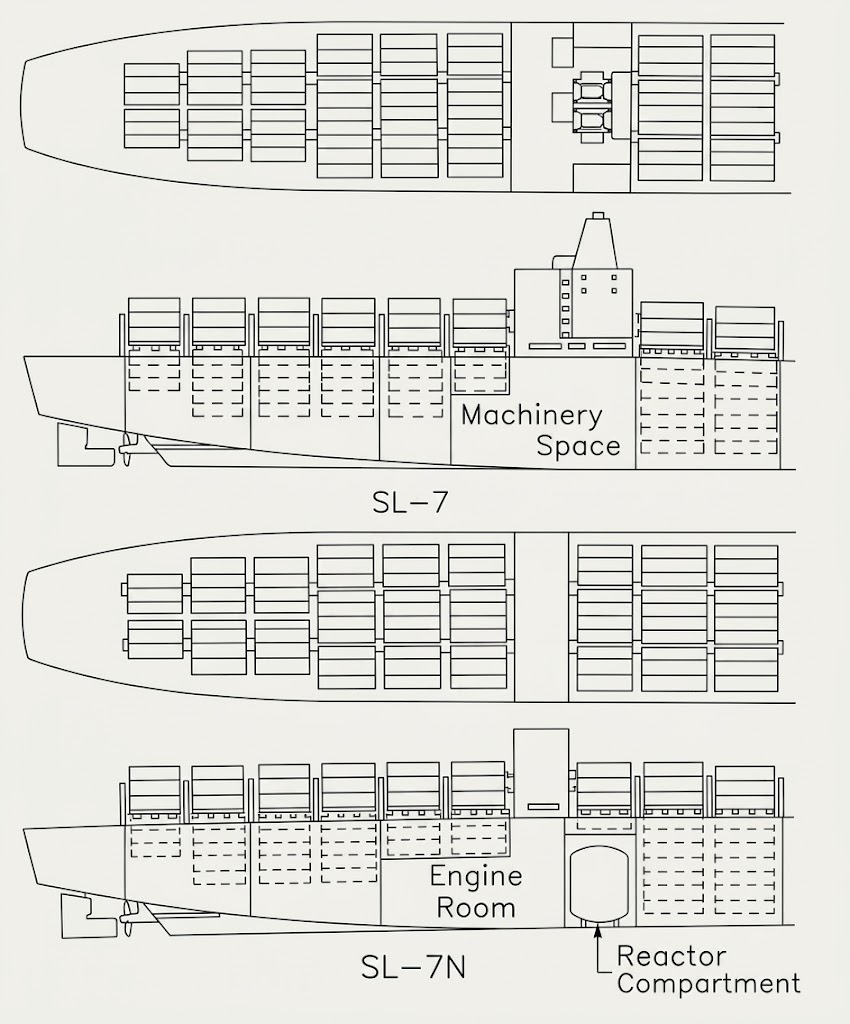
Nuclear propulsion was not considered in the 2022 repowering study but was actually considered in the original design of the Sea-Land SL-7 container ships. Malcolm McLean decided against nuclear propulsion because it would take too long to design and build the propulsion plants and there were uncertainties about port entries of nuclear vessels. That was in the 1970’s and now we are living in a different world.
John Boylston, the original designer of the SL-7’s and the originator of the below discussion, even found an original concept sketch of nuclear SL-7’s in his files.
There is a stone cold reality about nuclear propulsion. Nuclear ships are steam vessels. If MARAD wants nuclear propulsion they do not just need nuclear reactors, they also need steam turbines and steam operating engineers.
Bizarrely MARAD is now scrapping some of their most valuable sealift vessels with perfectly good and proven steam plants.
Once these vessels are scrapped MARAD will start new studies for nuclear ships. That is government procurement and how much money and how much time will this take? When will these nuclear ships enter service and how much will they cost?
At the time of writing of this blog MARAD announced a Memorandum of Cooperation with Core Power. That includes a proposal for nuclear propelled vessels with an anticipated start of construction in 2028. It lacks further hard details and assumes maritime industry investment.
Meanwhile, there are 8 ships that were designed for nuclear propulsion and require remarkably little work to convert to nuclear propulsion. The after portion of the RO/RO hold will become the nuclear reactor compartment, the huge boilers will be scrapped and the steam generated by the reactors will be piped to the existing steam plants. The Core Power reactors are particularly well suited for the SL7’s since they can generate superheated steam.
Even in the original design the cargo capacity was unaffected and as a RO/RO can be significantly increased with a nuclear conversion.
Will it be the most optimized nuclear steam plant or nuclear vessels ever developed? Not likely, I suspect there will be a need for some permanent ballast to get the fore and aft trim right. However, I will bet dollars to donuts that a program like this will advance nuclear propulsion development by years, if not a decade. The most significant benefit is that it will get nuclear cargo ships running and develop operating experience because nothing is perfect on the first pass anyway.
As logistics support vessels their duty cycles will allow operation without having to carry the burden of initial commercial competition against non nuclear commercial cargo vessels and provide a more flexible training environment. It is noted that nuclear vessel economics favors high speed and these vessels already are high speed designs.
Moreover, there are 8 vessels. If the first conversion is a raging success, MARAD can rapidly build a class of 8 nuclear FSS ships without additional engineering cost and with the benefit of series construction cost. In addition, running a class of 8 nuclear FSS’s will benefit operational costs, training efficiency and manning flexibility within the national sealift fleet.
As oil burners these vessels were not aggressively run due to their high fuel costs, but with nuclear propulsion they can become the prime MSC cargo movers. At zero additional fuel cost and at high speed (lower crew cost), they would warrant a higher duty cycle in lieu of internal combustion vessels in the MSC fleet.
If the first installation is not a success, or the first supplier of a modular reactor turns out to be a false start, the next supplier’s reactor can be installed in the next vessel. Even more interesting, there can be a supplier face off. Each supplier gets a vessel to convert and may the best supplier win.
Recently MARAD and associated US government entities have started to focus on a goal of regaining technology dominance in maritime. Technology dominance can only be achieved by high speed implementation of cutting edge technologies. Dominance is doing; not talking.
Preserving the SL7/FSS’s for conversion to nuclear technology is a unique opportunity to steal a march on the rest of the world. Meanwhile, scrapping these vessels may very well turn out to be a career crushing embarrassment in the Colin Powell mode.
Converting all 8 vessels to nuclear propulsion will not happen overnight. To take one or two of these vessels and use them as public educational spaces in the SL7Expo mode will be an added benefit.
Five or ten years from now the SL7Expo vessels may go back into service after conversion to nuclear propulsion. And that is just fine, because an operating historical vessel always beats a static historic vessel anyway.
There is no reason the US legacy of innovation and “gitter dun” cannot carry on, but only if MARAD wakes up and takes advantage of its assets, instead of engaging in pie in the sky dreams.