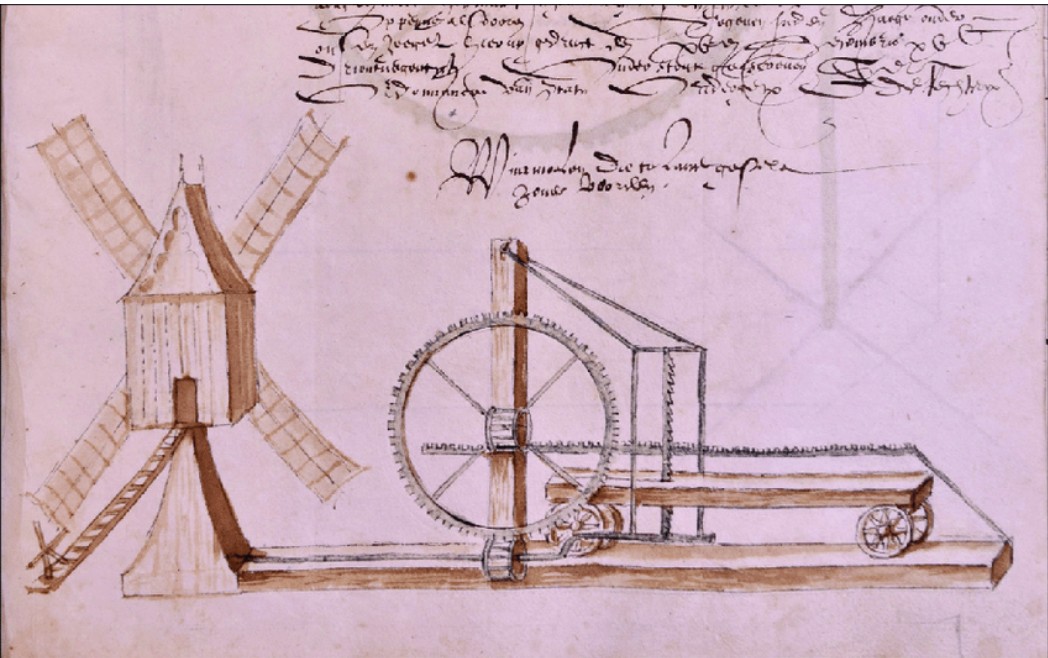

Illustration of the patent application for a wind-powered sawmill by Cornelis Cornelisz van Uitgeest. Patent drawing in the resolutions of the States of Holland, 1593 (NA, The Hague).
Every now and then it is fun to see what AI returns on a potentially controversial and fuzzy question. I don’t remember why, but somehow I asked AI the following question:
“Per capita which country has had the most outstanding engineers”
This was the answer:
When looking at the question strictly on a per-capita basis, the title for producing the most outstanding and historically transformative engineers generally comes down to a fierce contest between Scotland and Switzerland, with the Netherlands right alongside them for civil and hydraulic engineering.
While huge nations like the United States or England generated massive absolute numbers of innovators, smaller European countries with strong technical education systems, high literacy rates during the industrial era, and unique geographical pressures punched far above their weight.
Here is how the top per-capita contenders stack up:
- Scotland (The Industrial Revolution Powerhouse)
On a purely per-capita basis during the 18th, 19th, and early 20th centuries, Scotland is arguably unmatched. For a population that hovered around 1.5 to 4.5 million people during its peak innovation eras, its output of world-shaping pioneers is astonishing:
- The Scale: James Watt (steam engine), Thomas Telford (civil infrastructure), William John Macquorn Rankine (thermodynamics), James Nasmyth (steam hammer), John Loudon McAdam (modern roads), Alexander Graham Bell (telecommunications), and John Logie Baird (television).
- Why it happened: The Scottish Enlightenment combined with an advanced, accessible parish-school education system created an exceptional density of scientifically literate tinkers, academics, and practical mechanics.
- Switzerland (The Masters of Precision and Micro-Engineering)
If you measure per-capita output by precision engineering, watchmaking, mechanical innovation, and heavy civil works (like tunneling through the Alps), Switzerland takes a massive lead, particularly in the 19th and 20th centuries.
- The Scale: Pioneers of horology, electrical engineering, and chemical synthesis. Figures like Marc Isambard Brunel (though he worked primarily in Britain and France) and generations of mechanical geniuses who turned landlocked isolation into a powerhouse of precision manufacturing.
- Why it happened: Switzerland lacked natural resources and raw materials, meaning its economic survival depended entirely on adding maximum value through extreme precision, specialized technical schooling, and world-class civil infrastructure.
- The Netherlands (The Hydro-Engineering Titans)
If “engineering” is defined by reshaping geography and mastering hostile natural forces, the Dutch lead the world per capita.
- The Scale: From 17th-century pioneers like Cornelis Drebbel (inventor of the submarine) and early drainage innovators to modern architectural and coastal engineering giants like Johan van Veen (father of the Delta Works).
- Why it happened: Necessity. With a massive portion of the country below sea level, Dutch society treated engineering as an existential requirement, baking it into their national culture and institutions.
The Verdict
- If you measure by fundamental mechanical and industrial breakthroughs per capita, Scotland holds the crown for the modern era.
- If you measure by precision, civil mastery, and sustained technological execution per capita, Switzerland and the Netherlands tie closely for the honor.
It is easy to argue with the results, although in my mind there is no doubt that Scotland has an amazing engineering culture.
Meanwhile, it is interesting to dig a bit deeper into the AI answer. For example, to identify the inventor of the submarine is so incredibly subjective that I was not even aware that there was a Dutchman in contention for that title (although it turns out he has a pretty solid claim).
As far as Swiss precision engineering is concerned a number of years ago, I made the hilarious discovery that Malcolm Gladwell attributed the Norden Bombsight to the “Swiss” engineer Carl Norden. No doubt the Norden bombsight was the most complex precision engineered mechanical device ever created (although nowhere near as effective as its reputation), which would support the reputation of Swiss engineers, except for the fact that Carl Norden was Dutch.
The selection of Marc Isambard Brunel (the father of the better known Isambard Kingdom Brunel) as a Swiss example is even stranger. Marc Brunel was a brilliant engineer, but I could not find any reference that indicates he had any Swiss connection.
It kind of drops Switzerland out of the running as far as AI justification is concerned.
The reference to the father of the Delta Works, Johan van Veen is also odd. In the Netherlands Simon Stevin is considered to be the greatest Dutch engineer even though he may have been born in Brugge which is now Belgium. Johan van Veen was a very skilled engineer, but the Delta Works was not all his work.
While the Delta Works are sufficiently famous to be a tourist attraction, in pure engineering terms the wind powered sawmill may have been the greatest Dutch engineering feat. These mills revolutionized mass production, standardization, and hull design, and allowed the Dutch to be the most efficient shipbuilders of the era. The wind powered sawmillI provided the Dutch with a technological advantage that lasted for almost a century.
The engineer associated (although the term did not really exist at the time) with wind powered sawmills was Cornelis Corneliszoon van Uitgeest. (also known by the much cooler name of Krelis Lootjes). His design dates to 1593 and it allowed lumber to be produced 30 times faster than manual sawing.
The AI “Why it happened” explanations are also interesting. AI tries to distinguish the “why” between countries, but if we accept these three countries as the greatest engineering countries, there is only one reason and that is the reason AI provided for just the Scots.
The Scottish (Dutch and Swiss) Enlightenment combined with an advanced, accessible parish-school education system created an exceptional density of scientifically literate tinkers, academics, and practical mechanics.
Although I would use the term “tinkerer” rather than “tinker”, which in this context would refer to a specific metal working trade rather than a technical experimenter.
All of this may seem like fun trivia, but it is actually an interesting indictment of the inherent flaws in AI. AI can start an argument, but it can’t finish an argument. That requires human experience, judgement, and insight. To say nothing of irrational AI data bias and rational efforts to remove bias.
In actual fact, the proper AI answer would be: “Since engineers, even the great ones, tend to be anonymous, there is no reliable data that can answer this question.”
If AI were truly intelligent, I would not be surprised it would engage in some level of bias and judge great engineers against its own frame of reference. In that context the greatest engineers would live in the United States, since they were the ones that created AI.
But, as the below shows, those engineers could not get AI to draw a picture of a functional wind powered sawmill. Something Krelis Lootjes managed to do in 1593.