Note: For an overall discussion of this design concept go to: SHEWAC Aberration
Whether they were sailing ships of the line, dreadnoughts, aircraft carriers, or nuclear submarines, complexity has been the marine engineer’s stock in trade.
Even in the less glamorous designs such as tankers and bulk carriers, the level of complexity in these vessels is astonishing and has very much increased in the last 50 or so years.
While the dominant basic propulsion arrangement, slow speed diesel power, has not dramatically changed, ship prime mover auxiliary systems have. The first diesel ships ran on straight diesel fuel. Straight diesel fuel was much more expensive than coal or bunker C, and commercial pressure resulted in the use of heavy fuel oils on ships.
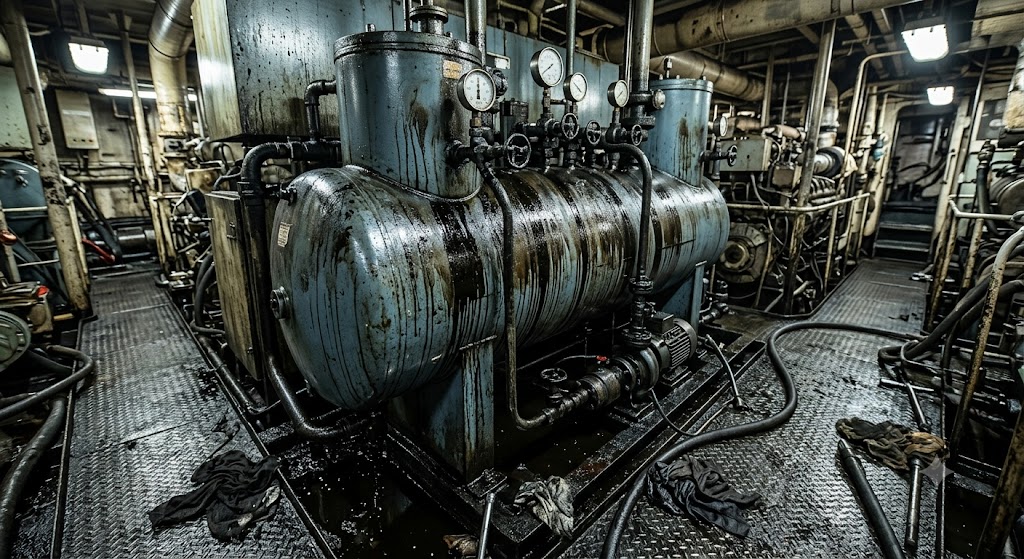
Inadvertently this is where the industry collectively lost its mind. I happily joined an industry that due to the use of heavy fuel oil was using fuel blenders, settling tanks, fuel oil heaters, fuel purifiers and waste oil incinerators. Then, to deal with the general mess it creates aboard a vessel, we provided everybody’s favorite Catch 22; Oily Water Separators.
As a young engineer I dove right in, and was part of the various battles to gain control of that madness until a junior engineer stopped me in my track with a simple question. She asked: “Why don’t we provide ships with clean fuel and leave the mess ashore? Ashore we can do it on a much larger and more efficient scale and the ships do not have to carry all that equipment around?”
The more one thinks about that, the more one has to agree that we suckered ourselves into a very bad vicious design spiral. Moreover, we were not done yet, because, we are running multiple sulfur level HFOs and DOs aboard ships, we are still forcing ship’s crew to deal with ECAs and are still incurring costs and encountering problems with stack gas remediation “solutions”.
The bottom line is: For nebulous commercial reasons, we brought a mess aboard and we have spent 50 years struggling with the mess.
The future can be very different. If we pay attention, we can create ships that are inherently cleaner, easier to maintain and easier to trouble shoot. That may seem counterintuitive, since hybrid systems, by nature, would indicate an increase in components. However, once we remove the diesel engine the total number of components will be drastically reduced, especially if we remove an HFO diesel engine.
I personally did not fully appreciate that until relatively recently.
In 2019 I partnered in the purchase of a 1989 Transworld 50 fantail trawler. A lovely boat with a very traditional diesel engine layout with a very nicely arranged engine room. Since she burns diesel, there is no need for purifiers etc, but there is a lot of stuff that requires tending, whether for oil changes, filter changes, leaks, corrosive issues or moving part failures. To become familiar with all the parts is a very steep learning curve and the operation involves disposables such as waste oil, spent filters, solvents, sorbents and degreasers. Keeping things clean and dripless takes time and effort, even though in the realm of vessel operations she was one of the least demanding vessels one can ask for.
In 2021 I decided to design, and have Scarano Boats build me, a solar hybrid electric wheelchair accessible catamaran. The catamaran is 35 by 19 feet and has essentially the same speed, range and accommodations as the 50 foot trawler at about 30% of the displacement. Instead of typical catamaran twin diesel propulsion, this vessel is powered by twin electric outboards, batteries, solar panels and a 15 kW standby diesel generator.
Unavoidably, to be able to have acceptable cruising range with today’s technology, a diesel generator is required. However, when comparing the mess of one conveniently located diesel generator with two buried propulsion engines and another diesel generator, this arrangement has already removed 66% of the mess we normally have to deal with.
I too thought that the benefit of reduced mess would be outweighed by increased overall complexity of the other hybrid electric drive components, but this is where I was most surprised once the boat became operational.
The design of the electrical system was a complex exercise, but the installation maintenance and operation reminded me of the days of home assembling PC’s. Once you know what you are doing, none of it is particularly unpleasant or complicated, except maybe for the software learning curve. And, quite frankly, modern diesel engines also have software learning curves.
From an operational point of view, troubleshooting is extremely linear. Rather than worrying about the multiple failure paths in an engine (Fuel, lubrication, compression, injection, ignition, etc) the failure path in a hybrid electric drive system is linear. If something does not run, find the point where there is no voltage and your problem is one step upstream. All of that can be performed with a voltmeter rather than needing wrenches, replacement gaskets, drain cans, rags, and Gojo.
To really take advantage of the difference requires smart design, since a bad hybrid design is as bad as a bad diesel design. Like any boat, the commissioning and shake down of the SHEWAC has involved a healthy dose of trouble shooting, but taking into account that it is a cutting edge system, the troubleshooting once properly developed can be clean, remarkably quick, transparent and obvious. “Obvious” means that once there was a problem in the hybrid system, it was possible to identify the offending component with great certainty, rather than to perform trial and error component replacements.
Undoubtedly, today, my biggest maintenance concern is the standby diesel generator. It is a necessary evil until something better comes down the pike. The least pleasant job by far is oil changes. Since solar and shore power provide most of the operational energy, the generator does not accumulate a lot of hours and I do not have to change the oil but once a year and then only as a seasonal convenience (by itself a carry-on benefit of hybrid design). But besides oil changes, fuel filter replacement and, even worse, injector bleeding, are also antithetical to proper housekeeping.
In designing the SHEWAC it turned out it was quite easy to ensure that every component in the boat is modular. While the entire system was more expensive than a conventional diesel propulsion set-up, the largest cost component is the diesel generator, representing about 4% of the total construction cost, much less than the cost of a single diesel prime mover. That means that for relatively little cost (as compared to diesel prime mover replacement) I can swap out for better solar panels, better batteries or, whatever other stored energy conversion technology I can plug into the core electric system once it becomes economically available.
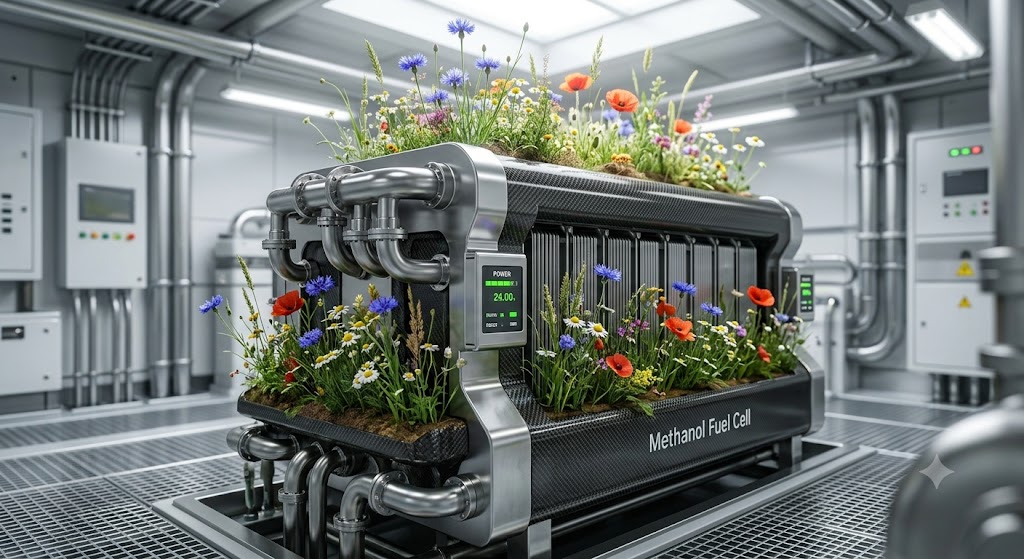
Which then raises the subject of alternative fuels, some may argue for bio diesel, some may like the idea of LNG or Ammonia. LNG or Ammonia can run in IC systems and can be expected to run cleaner both in exhaust and operation than bio diesel, but it is still lots of noisy, smelly, spinning, gasketed, sealed, oiled and combusted stuff. I hope to avoid all that stuff and not too long from now hope to be able to get rid of the IC generator (for which I have already fitted the chain fall hardpoint and which can be removed in about three hours) and install something like methanol fuel cells.
It will not happen overnight, but it took us 50 years to disentangle ourselves from the heavy fuel oil nightmare. Let’s learn from that mistake. Let’s take advantage of the right alternative fuels and design ships without unnecessary messy maintenance entanglements.
Note: The pictures are obviously AI, but the flowers on the fuel cell is not a bad idea.